- Hits: 2115
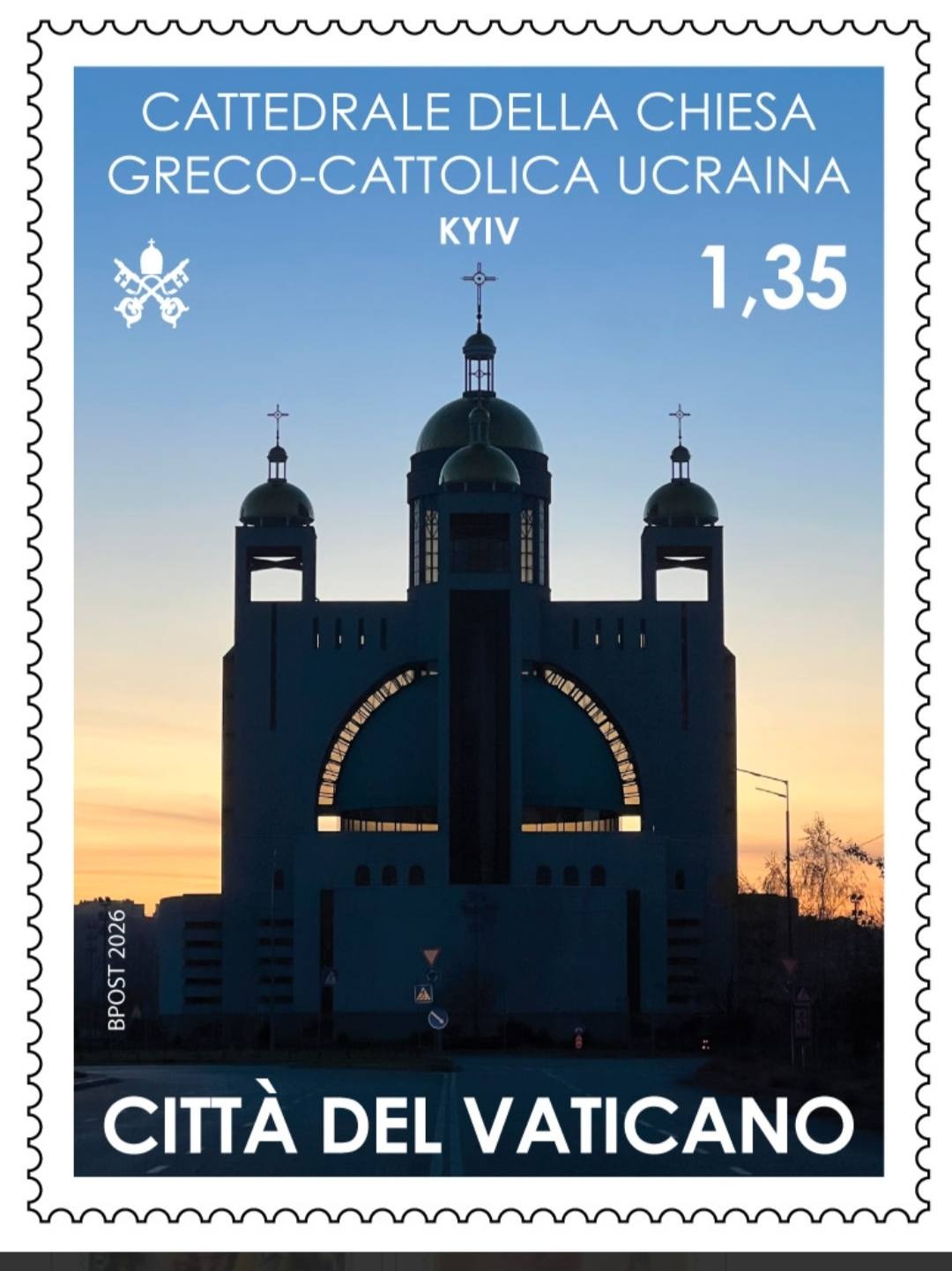 The Post and Philately Service of the Governorate of Vatican City State is issuing, on 26 February 2026, a special stamp dedicated to the Ukrainian Greek Catholic Church. The UGCC in recent years has lived through events of profound historical and spiritual importance, notably the transfer of the Archeparchy’s seat from Lviv to Kyiv on 21 August 2005 and the consecration of the Patriarchal Cathedral of the Resurrection of Christ in Kyiv on 18 August 2013.
The €1.35 stamp features the Patriarchal Cathedral of the Resurrection of Christ in Kyiv, consecrated in 2013. The design shows the cathedral’s façade in darkness—its lights dimmed in solidarity with the Ukrainian people during wartime—against a softly glowing evening sky that evokes resilience and hope beyond adversity.
This issue will also be available in a special mini-folder with a commemorative envelope, forming part of the Vatican’s first 2026 philatelic series.
Read more: Vatican Issues 2026 Stamp Honors the Ukrainian Greek Catholic Church
- Hits: 5423
 In this interview for BOMARKA, American philatelist Ingert Kuzych speaks with Ukrainian journalist Oksana Lukashuk about the power of postage stamps to tell Ukraine’s story to the world. Kuzych, an agronomist by profession and a philatelist by vocation, reflects on his lifelong passion for Ukrainian history and philately, from childhood stories told by his Ukrainian father to decades of collecting, research, and writing. The conversation traces his role as initiator and sponsor of the Heorhii Narbut Award, which helped raise the artistic standard of Ukrainian stamp design, and explores the significance of Western Ukrainian issues, wartime stamps, and diaspora philately.
Mr. Ingert, what connects you with Ukraine?
Ukraine is literally in my blood and in my psyche. By heritage I am only half Ukrainian since my mother was Austrian. (My parents met after World War II when my displaced-person father found himself working on an Austrian farm owned by a man who would become my grandfather (my mother’s father)). My historian father was a master story teller and growing up he would regale my sister and myself every evening with a new story. We loved these sessions and I was constantly amazed at all the wonderful tales he came up with. Anyway, the yarns usually involved a fearless and intrepid Cossack or prince who had to overcome all sorts of obstacles to win a fair maiden. I thus became deeply (and somewhat romantically) imbued with Ukrainian history. As I grew older, I made it a point to learn more about Ukraine. But it was not always easy since Ukraine was then not a recognized country. But it HAD been a country and I saw it as important to let others know that. So I set out to collect lots of things connected with Ukraine, especially books, folk art (particularly pysanky), and stamps.
- Written by: Mark Stelmacovich
- Hits: 3087
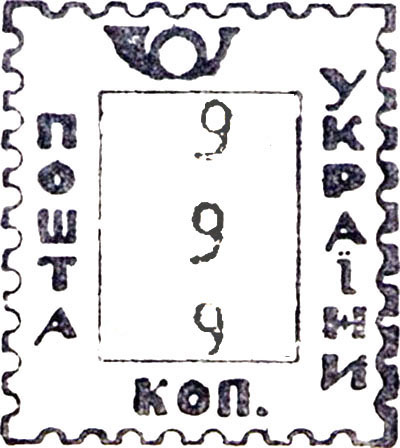
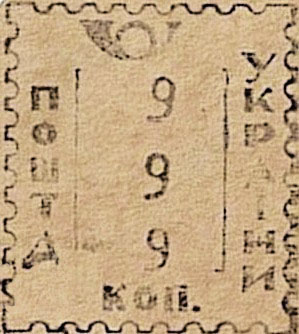
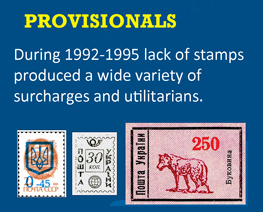
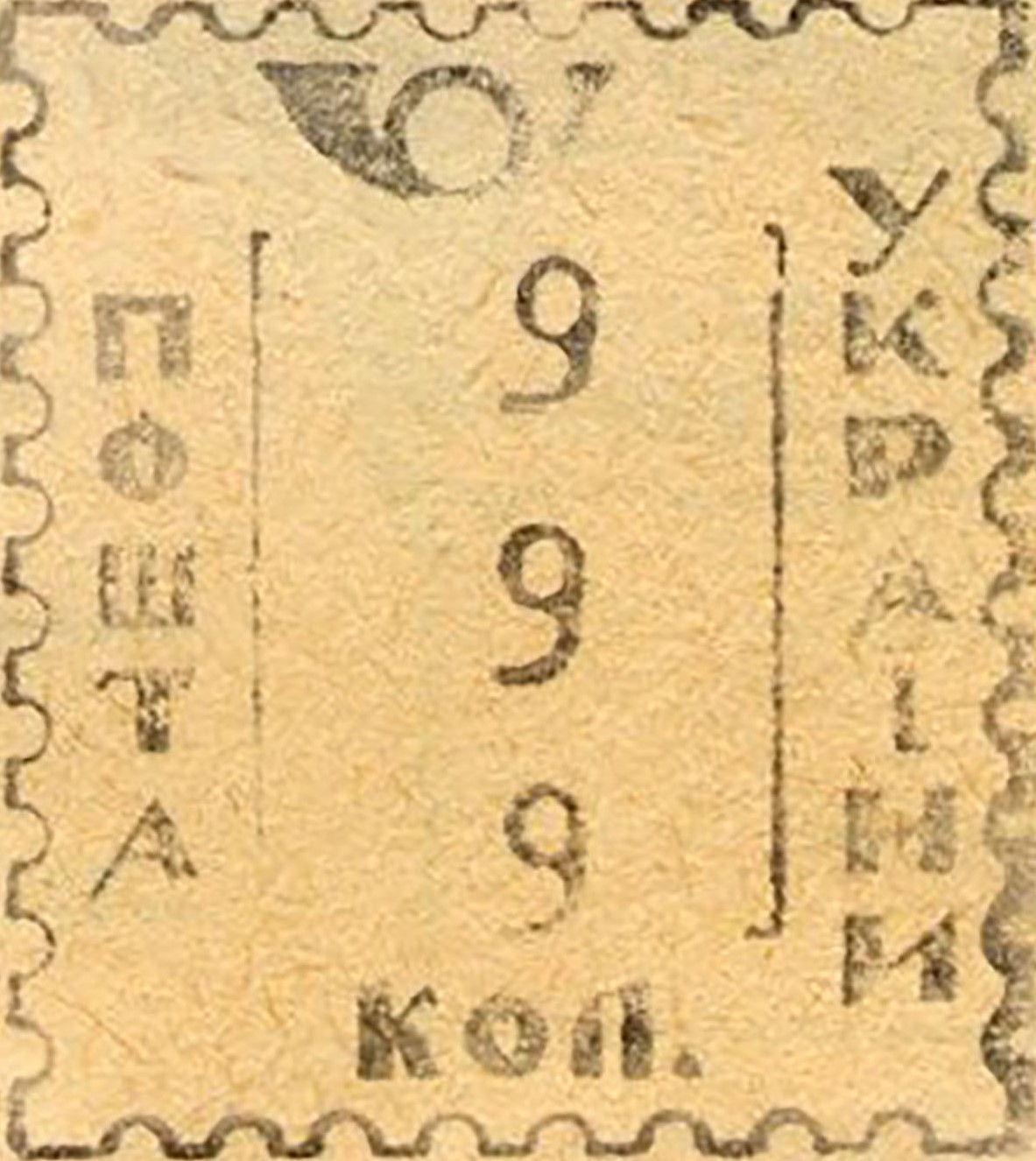 As I continue to grow my 1990s provisional exhibit, studying and researching items as to postal significance and history often becomes an eye-opening experience. ‘Revelations’ is an example. As Andy Martyniuk made a point of, in Lobko·2 (isbn 1889581135) page·xi, …
‘Stories from this period in Ukrainian postal history are often humorous, but at the same time heartbreaking. For example, during the Soviet era, all post offices (including communication centers), due to their inherent power of influencing the populace, were kept under the strictest control and centrally managed to the greatest extent possible from Moscow. When domestic control ensued, Ukrainian main post office personnel were not even aware of the location and total number of post offices under their ‘control’. These circumstances resulted in smaller post offices becoming isolated and rudderless, …’.
So there was a ‘quiet chaos’ immediately upon 1990s independence. With keeping the mail flowing as the primary objective, you all too often do not see officially acknowledged procedure, notably at the more local postal levels where, clearly, the provision of official documentation was secondary at best, and, really, unnecessary toward getting on with the job.
Read more: Reporting Key 1990s Ukraine Provisionals Material
- Written by: Mark Stelmacovich
- Hits: 3845
The premise of this table is that the price of an item logically reflects its availability or lack thereof relative to others. Pricing based upon ‘Провизорные Выпуски Украины 1992-1999 гг.’ (‘Provisional Postage Stamps of Ukraine 1992-1999’), Third Edition, by Hryhoriy Lobko, ©2008, isbn 9789668550577;
Make sure to carefully read the ‘Notes’ section at the end, in order to best understand the data. For example, you will then find out that ‘t’ means ‘tariff’, why so many of them are clumped together (‘t2t3t4’ followed by a value common to all three of those tariffs), and so on for other details.
Then, outside of the data in general, concentrate specifically on the first two columns that form a data summary, the first that ranks each cover type in value order ‘1-to-458’ (there are lots of ‘ties’), the second that completes a percentage value for each given stamp in comparison to each other, and the last that does the same for covers. The higher the figure per item, the scarcer/rarer the cover, and in terms that are now quantified.
- Hits: 1455
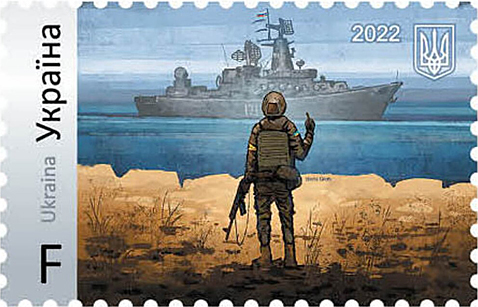
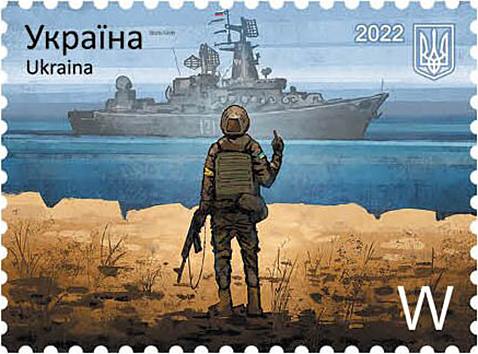 Imagine standing on an island and a Russian guided missile cruiser shows up on your shore. The “Moskva”, flagship of the Russian Navy, is carrying 16 missiles with a crew of 510. The warship announces "Snake Island, I, Russian warship, repeat the offer: put down your arms and surrender, or you will be bombed. Have you understood me? Do you copy?" There is nowhere to run. Surrender? Of course, not an option. The Ukrainian border guard responds with a defiant "Russian warship, go f--k yourself."